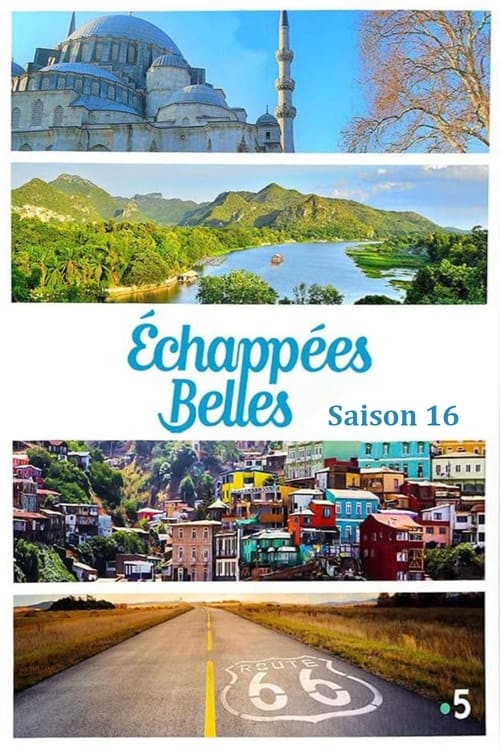
When Échappées Belles premiered on France 5 back in September 2006, it arrived with a simple yet compelling premise: take viewers on intimate journeys across unfamiliar landscapes and let the destinations speak for themselves. What Stéphane Bouillaud created wasn’t just another travel documentary—it became a cultural phenomenon that would sustain itself for nearly two decades, accumulating 683 episodes across 20 seasons. The fact that audiences kept returning, that critics maintained a solid 7.8/10 rating, and that the show kept getting greenlit tells you something important: this was television that understood the power of genuine exploration.
The genius of Échappées Belles lies in its fundamental respect for both destination and viewer. The 90-minute runtime wasn’t arbitrary—it was a conscious choice that allowed for proper immersion. Rather than rushing through picturesque snapshots in 45 minutes, Bouillaud and his team gave themselves time to breathe, to linger, to actually discover alongside the audience. This pacing became the show’s signature, distinguishing it from the more frenetic travel programming that dominated mainstream television. You weren’t watching a checklist being ticked off; you were experiencing something closer to an extended conversation with a place.
What made the show resonate so deeply came down to its documentary DNA combined with an almost human-centered approach to travel storytelling. This wasn’t about luxury resorts or Instagram-friendly moments—though beautiful imagery certainly appeared. Instead, the program seemed genuinely interested in the people who inhabited these spaces, their customs, their challenges, their joys. That authenticity became Échappées Belles‘ calling card:
- Intimate encounters with locals that felt unscripted and genuine
- Slow exploration of regions that revealed layers beyond the obvious tourist attractions
- Cultural sensitivity that treated destinations with intellectual and emotional depth
- Accessibility that made far-flung places feel connected to viewers’ own lives
- Consistency in quality that allowed the audience to trust the show’s judgment
The show’s twenty-season journey speaks to something often overlooked in modern television discourse: the staying power of well-crafted documentary work. In an era when networks chase viral moments and algorithm optimization, Échappées Belles quietly accumulated nearly seven hundred episodes by simply doing one thing exceptionally well. Season after season, the show demonstrated that audiences didn’t need manufactured drama or celebrity personalities to remain invested. They needed authenticity and wonder—precisely what Bouillaud delivered.
> The program’s greatest achievement might be its demonstration that television’s golden age wasn’t about prestige drama or complex serialization—sometimes it was about a camera, a curious eye, and the willingness to spend ninety minutes truly seeing a place.
Consider the cultural conversation the show sparked within its French broadcasting context. Échappées Belles became more than entertainment; it functioned as a kind of visual humanities project, opening windows onto regions that might otherwise remain distant abstractions for viewers. The show influenced how France 5 approached documentary programming and established a template for travel television that emphasized depth over superficiality. Other networks noticed. Other creators took inspiration from this formula.
What’s particularly striking about the show’s trajectory is how it avoided the creative burnout that typically derails long-running series. Twenty seasons and 683 episodes represent an extraordinary output, yet the show maintained returning series status with an audience willing to stick around. This suggests Bouillaud found ways to keep the format fresh without betraying its core identity. The destinations changed, the cultural contexts shifted, the world itself transformed between 2006 and now—yet the fundamental approach remained: respectful, curious, unhurried.
The rating of 7.8/10, while perhaps seeming modest on paper, actually reflects something important. This wasn’t a show engineered for universal acclaim or designed to generate passionate fandom discourse. It occupied a different space—that of reliable, intelligent programming that earned genuine appreciation from those who engaged with it. The consistency of that rating across twenty seasons suggests the show delivered what it promised without pretense.
The creative vision behind Échappées Belles ultimately represents a philosophy about what documentary television can accomplish. Rather than pursuing novelty or spectacle, Stéphane Bouillaud chose to deepen, to investigate, to sit with his subjects long enough to understand them. In those ninety-minute blocks, he created space for contemplation—a increasingly rare commodity in contemporary broadcasting.
Looking back from today’s television landscape, Échappées Belles feels almost radical in its restraint and confidence. The show trusted that viewers genuinely wanted to understand the world beyond their immediate experience. It trusted that ninety minutes of genuine exploration would outperform forty-five minutes of manufactured excitement. Most importantly, it trusted that documentary work didn’t need celebrities, drama reconstructions, or artificial tension to merit attention.
For anyone who considers themselves a television enthusiast, Échappées Belles deserves recognition as one of those shows that quietly proved television could be both popular and substantive, entertaining and enriching. It’s a long-running series that actually earned its longevity—something worth celebrating in any era.