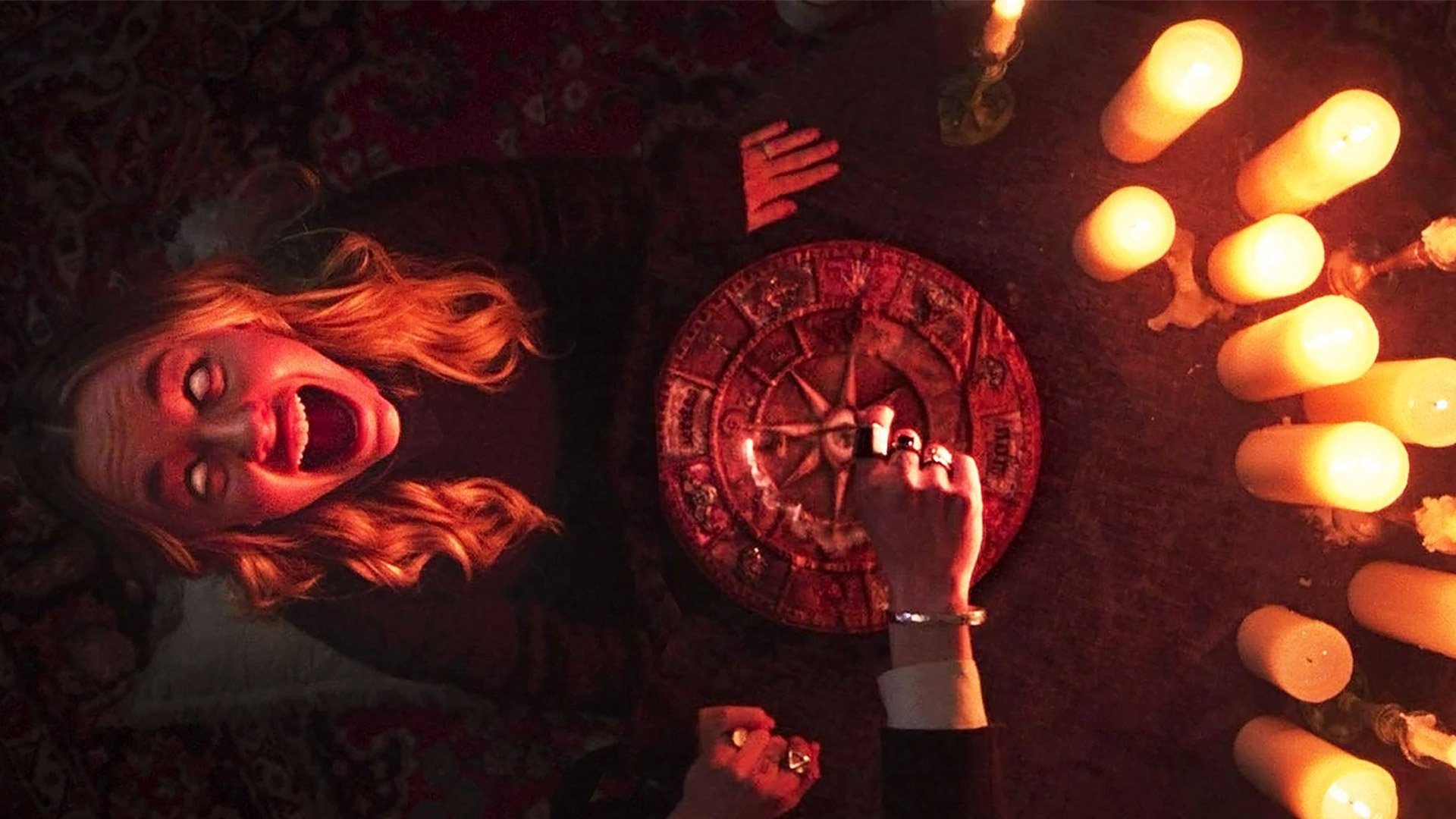
When Witchboard came out in August 2025, it arrived with considerable fanfare—a $20 million supernatural horror film directed by Chuck Russell, a filmmaker known for his work on genre projects like A Nightmare on Elm Street 3. The premise was straightforward enough: a cursed Ouija board awakens dark forces in New Orleans, trapping a young couple in a nightmare of possession and deception. Madison Iseman and Aaron Dominguez carried the film as the central couple, with Melanie Jarnson rounding out the cast. On the surface, it seemed like the kind of mid-budget horror that could find an audience. Instead, what emerged was something closer to a cautionary tale about the gaps between ambition and execution in modern horror cinema.
The reality of Witchboard‘s performance tells a sobering story. The film grossed $480,640 against its $20.00 million production budget—a staggering miss that ranked among the year’s most notable box office disappointments. With just 5.8/10 from 43 votes, audience reception was tepid at best. This wasn’t a case of critical misunderstanding meeting devoted cult appreciation; this was a film that struggled to connect with viewers on any meaningful level. For a horror picture released in the increasingly crowded streaming-adjacent theatrical market, that disconnect matters enormously.
What went wrong? Part of the answer lies in the crowded supernatural horror space of 2025. The market was already saturated with possession narratives, Ouija board variations, and New Orleans-set occult thrillers. Russell’s vision—whatever it was meant to be—didn’t stand out from that noise. The 113 minutes runtime suggests a film that may have been trying to do too much or, conversely, padding to reach feature length. Neither option is ideal when your core concept has been explored dozens of times before in more distinctive ways.
> The creative challenge here wasn’t conceptual—it was execution. How do you make audiences care about another cursed object film when the supernatural horror space has been thoroughly mined?
That said, dismissing Witchboard entirely misses what it represents in the broader context of 2025 horror cinema. The film was a studio gamble on practical horror—the kind of mid-budget supernatural picture that streaming platforms have largely cannibalized. Russell brought an old-school sensibility to the project, someone who understood how to work within genre constraints. Iseman, fresh off higher-profile work, stepped into leading horror territory. These weren’t marquee names, but they were solid performers attempting to elevate material that may have simply been too familiar.
The casting of Iseman and Dominguez is worth examining more closely. Neither actor is known primarily for horror work, which could have been a strength—bringing fresh energy to tired tropes. Instead, the film seems to have wasted that potential. Their chemistry, their ability to sell the psychological unraveling of a couple under supernatural siege, never quite emerged as a compelling through-line. The blame doesn’t lie entirely with the actors; it falls squarely on structure and screenplay.
What Witchboard ultimately illustrates is the precarious position of theatrical horror in 2025. The economics simply didn’t work. A $20.00 million investment requires either substantial word-of-mouth or a pre-existing fanbase willing to show up opening weekend. Witchboard had neither. The Ouija board trend peaked years ago with Ouija: Origin of Evil (2016). New Orleans gothic horror is solid thematic ground, but it’s not inherently marketable anymore. Without a fresh angle—some twist, some distinctive visual or thematic approach—the film was always swimming upstream.
The film’s legacy, if it has one, is instructional rather than inspirational. It’s a case study in how mid-budget horror can fail when it lacks both originality and the kind of director-driven vision that justifies taking risks. Russell’s involvement suggested something more ambitious than what materialized, but perhaps the constraints of the budget or studio oversight limited what he could achieve. Horror fans who did see it reported a competently made but unremarkable experience—the kind of film that leaves no impression, good or bad.
There’s also the matter of timing. The shift toward streaming releases means theatrical horror has to earn its multiplex real estate differently than it did even five years ago. Witchboard came to theaters as a theatrical release because it was made for theatrical distribution, but by 2025, audiences had been conditioned to expect that kind of supernatural fare on-demand. The film existed in an awkward temporal space, arriving at the tail end of theatrical horror’s prominence without adapting to a new viewing landscape.
For critics and industry observers, Witchboard became a reference point for what doesn’t work in contemporary horror—not because it was offensively bad, but because it was aggressively middle-of-the-road. It had the budget for quality production values, experienced professionals involved, and a concept that should theoretically work. Yet it failed across the board. That failure reveals uncomfortable truths about audience taste, about the exhaustion of certain horror concepts, and about the diminishing returns of mid-budget theatrical horror as a sustainable business model.
Looking back from late 2025, Witchboard is less significant for what it accomplished and more significant for what its failure represents—a moment when the traditional horror marketplace proved less forgiving than ever, and when execution became genuinely critical to survival.