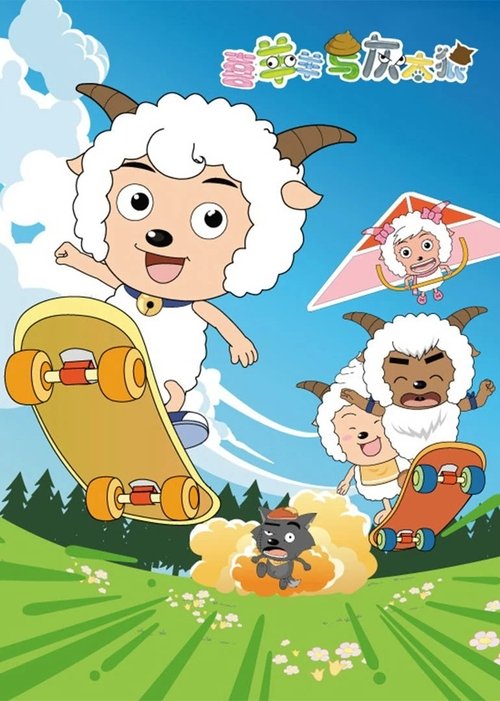
When Pleasant Goat and Big Big Wolf premiered on August 3rd, 2005, it arrived at a pivotal moment for children’s animation in Asia. Creator Leo Huang envisioned something deceptively simple—a show about resourceful goats outsmarting a bumbling wolf on the Green-Green Grassland—but what unfolded over the next several years became something far more significant. The show tapped into a storytelling formula that would resonate across generations, spawning not just a single season, but an astonishing 530 episodes that maintained viewers’ engagement through sheer creative consistency and charm.
The premise itself is elegant in its simplicity: a wolf couple moves to the forest adjacent to the grassland where a group of goats lives peacefully, and chaos—comedic, heartwarming chaos—ensues. But here’s what makes this concept endure beyond its initial premise. Rather than relying on cynicism or mean-spirited humor, the show built its foundation on something more universally appealing: the triumph of intelligence and friendship over brute force. The goats weren’t victims waiting for rescue; they were active participants in their own survival, using wit, teamwork, and increasingly inventive solutions to protect their home.
What truly stands out about the show’s approach is how it leveraged the 15-minute episode format as a creative advantage rather than a limitation. This runtime demands tight storytelling, rapid pacing, and the ability to establish conflict, develop it, and resolve it within a compact timeframe. Rather than bloat the narrative, these constraints forced Leo Huang and the creative team to distill each episode’s essence—every joke needed to land, every plot point needed to matter, and character dynamics had to be crystal clear. The result was television that respected its audience’s intelligence while remaining undeniably entertaining.
> The show’s genius lay in understanding that children’s programming didn’t need to talk down to its audience. It could be simultaneously silly and clever, action-packed and character-driven.
The 7.4/10 rating deserves context here. In the landscape of children’s animation, this represents solid, respectable work that earned genuine affection rather than casual dismissal. Audiences didn’t simply tolerate Pleasant Goat and Big Big Wolf—they returned to it obsessively, and the 530-episode count reflects that sustainable engagement. That’s not filler; that’s evidence of a show that understood how to refresh its formula without abandoning what made it work.
The Cultural Footprint Across Asia
This show didn’t just premiere and fade into obscurity. It became a phenomenon that sparked real cultural conversations across Asian markets. The dynamic between the goats and wolves became iconic—each character developed distinct personality traits that audiences could latch onto and discuss. Pleasant Goat emerged as the leader, Lazy Sheep as the comedic foil, and Big Big Wolf as the villain who somehow remained sympathetic through his incompetence and occasional moments of genuine emotion. These weren’t flat archetypes; they were recognizable characters whose relationships evolved naturally across hundreds of episodes.
The show influenced the television landscape in subtle but meaningful ways:
- Animation aesthetics: The bright, appealing visual style became a benchmark for children’s animation in the region
- Comedy timing: The show demonstrated how to balance slapstick with character-driven humor in ways that worked for both children and adults
- Extended narrative: It proved that a single-season structure could encompass 530 episodes without becoming repetitive through consistent character growth and environmental variation
- Franchise potential: The success spawned spin-offs and films, including Joys of Seasons and Mighty Little Defenders, expanding the universe beyond the core premise
The Creative Vision Behind the Format
Leo Huang’s vision treated this show as something more than disposable children’s content. The 15-minute runtime, rather than feeling restrictive, allowed for a kind of episodic perfection. Each installment could stand alone while contributing to a larger tapestry of character relationships and recurring themes. This approach anticipated what modern streaming would eventually demand—bingeable content with consistent quality across numerous installments.
The show’s blend of Animation, Kids, Action & Adventure, Comedy, and Sci-Fi & Fantasy elements created a remarkably versatile framework. Episodes could range from straightforward chase sequences to surreal dreamscapes (as evidenced by later entries like the “Joys of Seasons” installment, where Lazy Sheep’s dreams become entangled with reality). This tonal flexibility prevented the show from becoming stale even across hundreds of episodes.
The comedy worked on multiple levels. Surface-level physical humor appealed to younger viewers, while clever dialogue and situational irony provided entertainment for older siblings and parents who found themselves watching. The wolf’s schemes were genuinely funny in their elaborate failure, yet never cruel—Big Big Wolf wanted to eat the goats, but his buffoonish nature ensured he’d never actually succeed. This created a narrative space where real stakes existed alongside a reassuring sense of safety.
Why It Endured
What made Pleasant Goat and Big Big Wolf truly special was its understanding that children’s animation could be consistently excellent across an extended run. The show ended in 2008 with its status as “Ended” rather than “Cancelled,” suggesting a natural conclusion rather than abrupt termination. That distinction matters. It suggests the creators knew when to end the story, preserving the show’s legacy rather than extending it past its natural lifespan.
Today, the show remains significant not as a relic of early 2000s animation, but as a case study in how to construct engaging children’s television. It proved that simplicity of premise combined with sophisticated execution could captivate audiences for hundreds of episodes. For anyone interested in animation history, children’s programming, or Asian television’s influence on global pop culture, Pleasant Goat and Big Big Wolf represents a moment when regional content achieved something genuinely special—it made people laugh, think, and care about its characters, one 15-minute episode at a time.