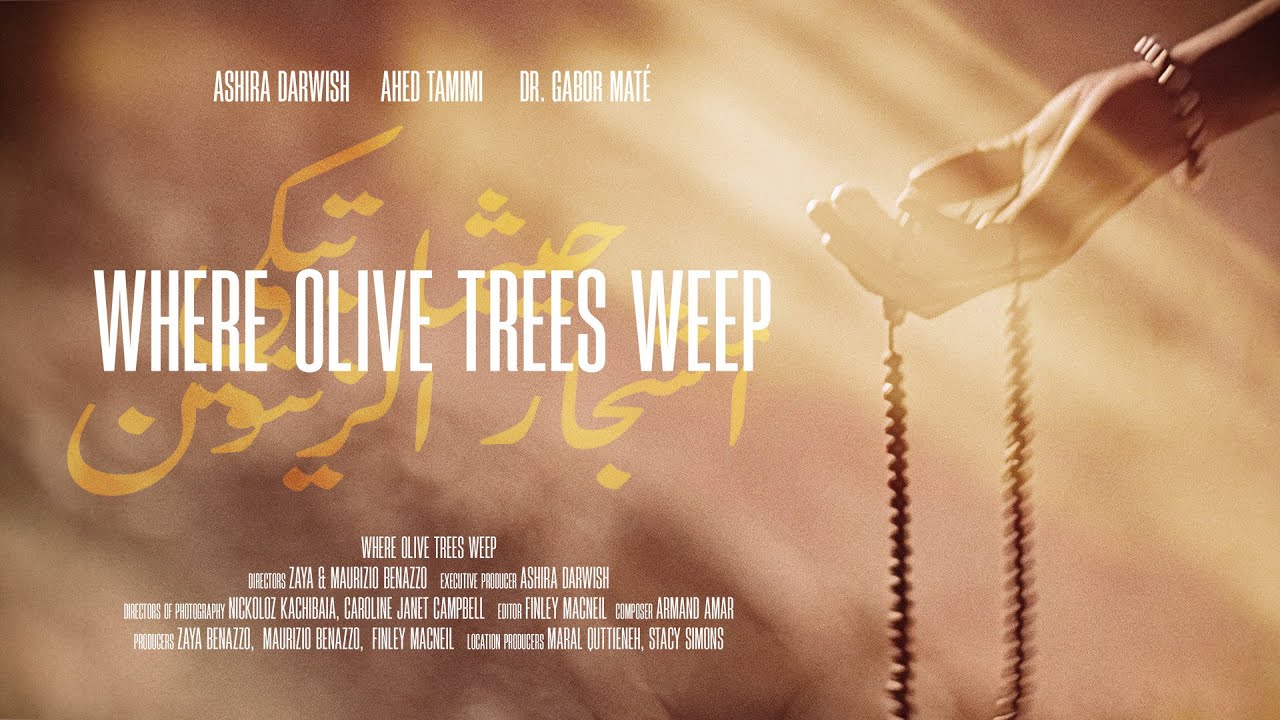
There’s something happening in documentary filmmaking right now that feels genuinely urgent, and Where Olive Trees Weep is set to be at the center of that conversation when it releases on January 29, 2026. Director Zaya Benazzo has assembled a project that goes far beyond standard documentary conventions—this is filmmaking with intention, assembled with collaborators who understand that cinema can be a form of witness, and sometimes, a form of resistance.
What makes this film so anticipated before its arrival is the remarkable lineup of voices bringing it to life. You’ve got Gabor Maté, the physician and author whose work on trauma and healing has influenced countless people seeking to understand intergenerational pain. Then there’s Ashira Darwish and Ahed Tamimi, whose presence signals that this isn’t a film made about Palestinians by outsiders—these are voices from within, from people who’ve lived these stories. That distinction matters enormously in documentary work, especially when dealing with subjects as sensitive and politically charged as occupation and displacement.
Why This Project Commands Attention
The film promises to offer what mainstream media often fails to deliver: a searing window into the struggles and resilience of the Palestinian people under Israeli occupation. But what elevates this beyond typical activism documentaries is the thematic focus on intergenerational trauma and resilience. This isn’t just about cataloging grievances—it’s about understanding how pain echoes through families, communities, and generations, and crucially, how people find ways to endure and resist.
- The creative partnership between Benazzo’s directorial vision and Maté’s understanding of trauma creates a unique framework
- Authentic voices from Darwish and Tamimi ground the narrative in lived experience
- The tagline—”Nobody is free until we are all free”—encapsulates the universalist ethics driving the project
- Science and Nonduality as the producing studio signals an approach grounded in both evidence and philosophical depth
There’s real anticipation building around this one, despite the somewhat curious detail that we’re still waiting for its official release date to arrive. The film carries a 0.0/10 rating on some databases currently, but that’s less a reflection of quality and more a symptom of the fact that nobody can actually rate something that hasn’t yet been seen. It’s a placeholder, really—a reminder that we’re in the space between promise and delivery.
The Landscape This Film Enters
By the time Where Olive Trees Weep arrives in early 2026, it will enter a cinematic landscape that’s becoming increasingly aware of the limitations of traditional documentary forms when addressing colonialism and occupation. There’s been a growing recognition that journalism alone isn’t enough—that we need frameworks that can hold complexity, trauma, and resilience simultaneously. Benazzo seems to understand this intuitively.
The partnership with Science and Nonduality is particularly interesting. This isn’t a mainstream studio making calculated commercial decisions. It’s a production company committed to exploring consciousness, healing, and the interconnectedness of human experience. That suggests Benazzo has been given space to make something uncompromising—a film that trusts its audience to sit with difficult material and come away transformed rather than simply informed.
“Nobody is free until we are all free.” This isn’t just activism rhetoric; it’s a philosophical statement about interdependence, about the impossibility of true peace when injustice persists anywhere.
What Benazzo Brings to This Story
Director Zaya Benazzo has proven herself capable of holding multiple dimensions in her work—the personal and the political, the spiritual and the material, the individual and the collective. With Where Olive Trees Weep, she’s tackling one of the most challenging subjects in contemporary global politics, and she’s doing it with collaborators who bring lived experience to every frame.
The 1 hour 44 minute runtime suggests a lean, focused narrative. This isn’t going to be a sprawling historical epic or a film that tries to resolve the Israeli-Palestinian conflict through documentary evidence. Instead, it appears designed as something more intimate—stories that illuminate larger truths, moments that reveal systemic realities, voices that can’t be ignored once you’ve heard them.
What makes this project so significant isn’t just its subject matter, though that’s clearly vital. It’s the approach:
- Trauma-informed storytelling that acknowledges psychological and historical wounds
- Collaborative witnessing rather than extractive documentary practice
- Spiritual and philosophical grounding alongside political analysis
- Focus on resilience as much as suffering—refusing the colonizer’s narrative of victimhood
The Ripples This Will Create
When Where Olive Trees Weep arrives on January 29th, it’s going to spark conversations that extend well beyond film festivals and criticism. The presence of Ahed Tamimi, a Palestinian activist whose own story represents resistance and intergenerational commitment, signals that this film isn’t neutral. It’s not attempting some false balance. It’s taking a clear ethical stance: that human dignity, freedom, and self-determination matter, and that telling these stories with nuance and care is itself a political act.
The involvement of Gabor Maté brings a framework that’s particularly relevant right now—understanding how trauma embeds itself in bodies and communities, how it gets passed down, and what healing might look like. This is documentary work that recognizes the psychological and spiritual dimensions of political struggle.
Film critics and cinephiles are already leaning forward, waiting to see what this collaboration produces. This is the kind of work that reminds us why documentary cinema still matters—why it’s essential. In a media landscape increasingly dominated by algorithm-driven content and shallow engagement, Where Olive Trees Weep is set to be a film of consequence, one that will be screened in communities, discussed in classrooms, and carried in the hearts of everyone who sees it.