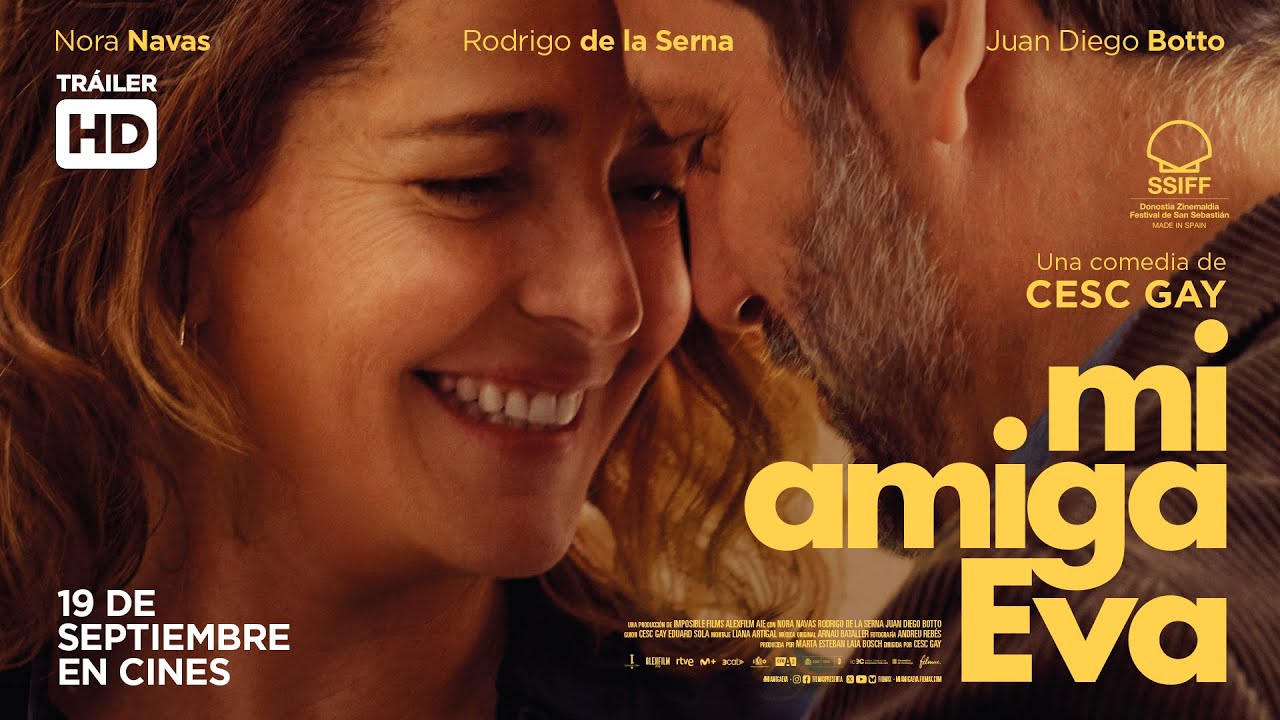
When Cesc Gay’s My Friend Eva premiered in September 2025, it arrived as a deceptively modest proposition—a brisk 100-minute romantic comedy with an intriguing central question embedded in its tagline: “Is love really all you need?” On the surface, that sounds like a familiar rom-com setup, the kind of question we’ve heard a thousand times before. But what Gay and his ensemble cast delivered was something more thoughtful, more layered, and ultimately more honest about the messy reality of desire and companionship in contemporary life.
Gay has built a reputation over his career for finding emotional depth within genre constraints. After the international success of Truman, he understood the value of combining accessible storytelling with genuine character complexity. My Friend Eva takes that sensibility and applies it to the romantic comedy format in ways that feel both timely and enduring. The film’s modest box office performance and the relatively modest critical reception—hovering at a respectable 7.0/10—tell an interesting story about where this film sits in the cultural landscape: not a blockbuster phenomenon, but something with staying power among those who connect with its particular perspective.
What Makes This Film Matter
> The real significance of My Friend Eva lies in how it interrogates the fairy tale promises we’ve been sold about love and partnership.
The film’s genius is in its refusal to offer easy answers. Rather than falling into the trap of resolving everything neatly by the final frame, Gay constructs a narrative that asks us to sit with ambiguity. Nora Navas carries the film with a performance that balances vulnerability with genuine strength—Eva isn’t waiting to be rescued, but she’s not indifferent to connection either. There’s a fascinating tension there that Navas embodies beautifully, making Eva feel like a fully realized person rather than a romantic prize to be won.
Alongside her, Rodrigo de la Serna and Juan Diego Botto provide distinct masculine energies that complicate the traditional romantic narrative. Rather than positioning one as “the right choice,” the film suggests something more interesting: that the men in Eva’s life represent different versions of what love and partnership could mean, and that choosing between them (or choosing neither) involves genuine loss no matter what. This refusal to provide a comfortable resolution is precisely what distinguishes the film from countless other romantic comedies cluttering streaming services.
The Creative Vision at Work
When you examine how this international production came together—with backing from Spanish studios Imposible Films and Mala Persona A.I.E., Portuguese Boavista Filmes, and Alexfilm AIE—you see evidence of Gay’s growing stature in European cinema. Filmax’s acquisition of global distribution rights speaks to confidence in the project, and the pre-sales in key markets like Italy and Germany before even its Cannes premiere suggested that European audiences recognized something valuable in what Gay was attempting.
The director’s approach to the material is notably economical. In just 100 minutes, he establishes:
- Eva’s journey back to Barcelona and her deliberate choice to rebuild her romantic life
- The competing relationships with two different men who offer distinct visions of partnership
- The broader question about whether romantic love remains the primary source of meaning and fulfillment
- A nuanced exploration of female agency and desire that avoids both cynicism and false optimism
That’s ambitious terrain to cover without the film feeling rushed or muddled. The tight runtime becomes an asset rather than a constraint—every scene earns its place, and Gay trusts his audience to understand the emotional subtext beneath the lighter comedic moments.
Why It Resonates
What My Friend Eva understands, and what makes it culturally significant despite not achieving massive commercial heights, is that modern audiences are hungry for romantic stories that don’t insult their intelligence. We’ve lived through enough real relationships, enough disappointments and genuine connections, to recognize when a film is being dishonest about how love actually works.
The film’s modest critical reception—7.0/10 from voters on the database—likely reflects its polarizing nature. Some viewers wanted more definitive romantic closure; others found the ambiguity frustrating. But that’s precisely the point. A film that everyone agrees about is often a film that’s playing it safe. My Friend Eva takes risks with its refusal to provide the comfort of a traditional ending.
Consider the key elements that make this work:
- Nora Navas’s central performance anchors everything—we trust Eva’s judgment because we see her thinking, doubting, and feeling in real time
- The supporting cast creates genuine chemistry rather than competing for heroic status
- Gay’s direction maintains tonal balance, finding humor in situations without letting that undercut genuine emotion
- The Barcelona setting provides visual poetry without overwhelming the intimate character work
The Lasting Significance
In an era when romantic comedies have largely retreated to streaming platforms and television, My Friend Eva represents something important: a serious filmmaker bringing his craft to the romantic comedy form and elevating it through intellectual and emotional honesty. The film won’t reshape the genre or inspire countless imitators, but it will endure for those who discover it—the kind of film you recommend to a friend when they’ve grown tired of both cynical deconstructions and false sentimentality.
The international collaborative nature of the production—spanning Spain, Portugal, and global distribution—also signals how European cinema continues to thrive in finding funding and audiences for intimate, character-driven stories. In a landscape dominated by franchise filmmaking and algorithm-friendly content, My Friend Eva stands as a reminder that stories about real people wrestling with real emotional questions still have an audience worth reaching.
What Gay has created here is a film that trusts its audience and trusts its material. That trust, ultimately, is what makes My Friend Eva matter.