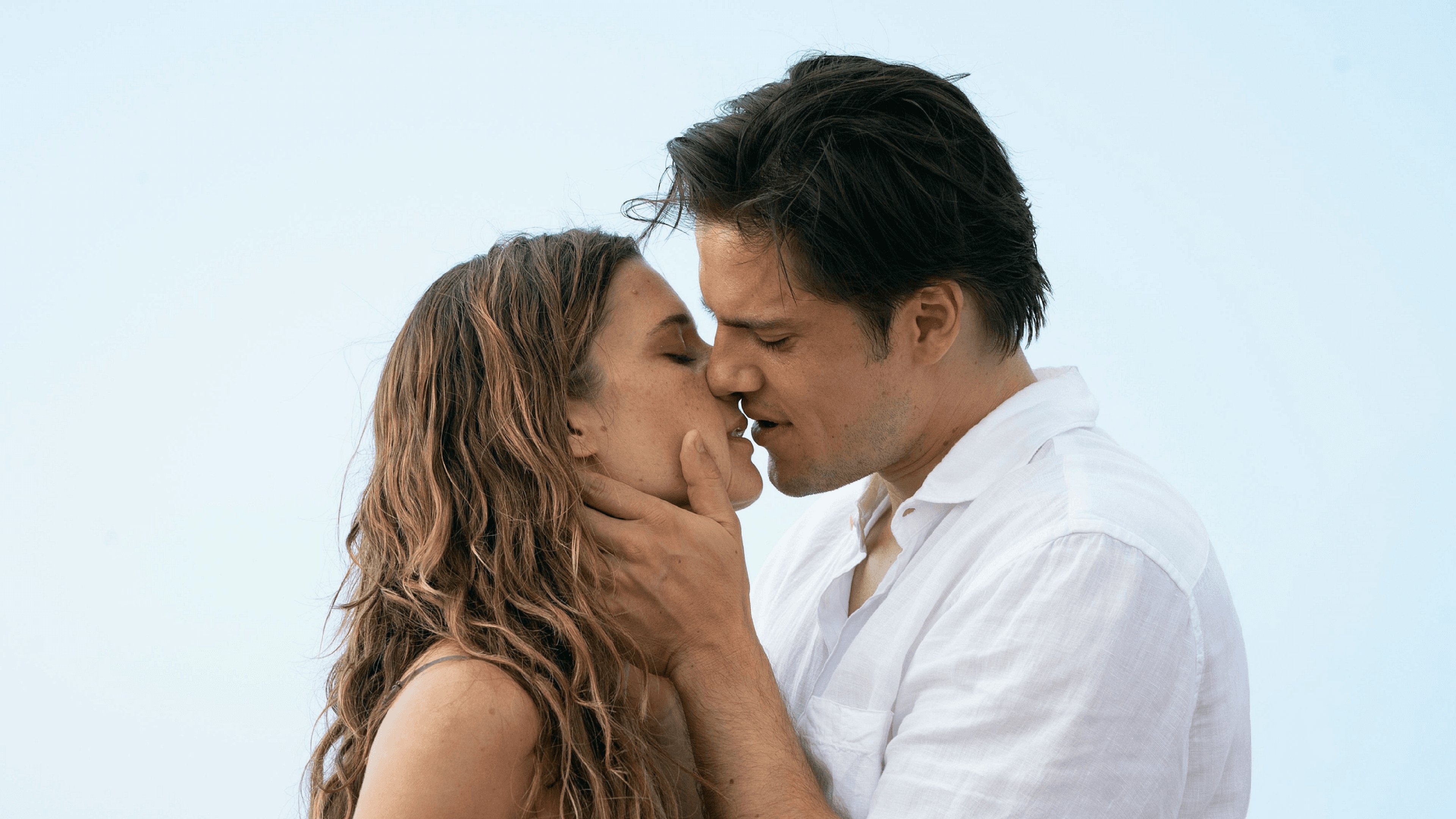
When Fall for Me premiered in August 2025, it arrived at an interesting crossroads in contemporary cinema—a moment when audiences seemed increasingly hungry for genre hybrids that refuse to stay neatly categorized. Director Sherry Hormann’s 1 hour 43 minute thriller-romance walked that tightrope with considerable ambition, even if it didn’t quite achieve the critical consensus it might have aimed for. With a modest 6.1/10 rating from nearly 200 voters, the film represents something worth discussing beyond its numerical score: it’s a work that attempted to complicate the romance genre by infusing it with genuine psychological stakes.
What Hormann brought to this project was a deliberate rejection of the straightforward love story. She understood that the most interesting romances often contain an undercurrent of danger, that attraction can coexist with doubt, and that falling for someone isn’t always a simple descent into comfort. The film’s very title carries that double meaning—there’s the romantic “fall,” sure, but also the possibility of an actual fall, a descent into something darker.
The ensemble cast deserves particular attention here. Svenja Jung carried the emotional weight of the narrative as someone learning to navigate trust in the aftermath of trauma. Theo Trebs embodied the kind of charm that can feel either reassuring or unsettling depending on the light, the angle, the moment—exactly what the material required. Tijan Marei rounded out the dynamic with a presence that complicated the traditional romantic triangle, suggesting there were larger social and personal forces at play than simple jealousy or competition.
> What makes Fall for Me particularly worth revisiting is how it understood that romance and thriller elements aren’t opposing forces—they’re mirror images of the same emotional intensity.
The pacing was notably economic. In an era where 120 minutes is often considered minimalist for dramatic storytelling, Hormann’s choice to keep things tight at 103 minutes felt like a statement. There’s no wasted space here—every scene serves either character development or plot momentum, sometimes both. This brevity also meant the film trusted its audience to fill in emotional gaps, to read subtext, to sit with ambiguity. That’s increasingly rare.
Financially, the project’s exact budget and box office performance remain undisclosed, which itself tells an interesting story about the current landscape of mid-tier European cinema. Whether we’re talking about a modest indie production or a studio venture that underperformed, the mystery actually adds to the film’s mystique. It wasn’t a runaway hit, but it wasn’t dismissed either—it occupied that interesting middle ground where artistic merit and commercial viability remain independent variables.
The critical reception, hovering around 6/10, reveals something worth examining:
- The film likely polarized viewers—some appreciated its refusal to offer easy answers, while others found that refusal frustrating
- It probably excelled in character work and atmospheric tension while potentially struggling with plot mechanics or pacing in certain acts
- Audiences may have arrived expecting one thing and received another, which can feel like a betrayal or a pleasant surprise depending on your disposition
- The horror-romance intersection it explored remains underexplored territory in mainstream cinema, making it brave even if imperfect
What’s genuinely interesting about Fall for Me in retrospect is how it contributes to an ongoing conversation about what romantic narratives can contain. The film suggested that you don’t have to choose between psychological complexity and emotional stakes—that a romance can be terrifying without being exploitative, can be suspenseful without sacrificing character authenticity.
Wiedemann & Berg Television’s involvement signaled a commitment to television-quality production values with cinematic ambition, and that hybrid approach is increasingly where interesting storytelling happens. The production company has long understood that the distinction between “prestige television” and “quality cinema” has become largely irrelevant. A 1 hour 43 minute runtime works equally well on a big screen or a streaming platform, and Fall for Me seems designed to thrive in both spaces.
Looking at where the film fits in 2025’s broader landscape reveals something telling. The year delivered its share of blockbusters and critical darlings, but it was the mid-budget, genre-curious projects that often lingered with viewers longer. Fall for Me doesn’t have the marketing saturation of bigger releases, nor does it have the festival circuit prestige of art-house darlings. It exists in that productive middle ground where films can actually take risks.
The legacy of Fall for Me may ultimately rest not in immediate recognition or awards consideration, but in how it expands the possibilities of what a contemporary romance-thriller can be. It demonstrated that Hormann understands intimate filmmaking—how to make audiences uncomfortable with attraction, how to suggest danger in a glance, how to use psychological doubt as a plot engine. For viewers who connect with that sensibility, the 6.1 rating becomes almost irrelevant. The film becomes something you return to, something that reveals itself differently on repeat viewings.
In an industry increasingly preoccupied with franchises and sequels, Fall for Me mattered because it was simply itself—a singular creative vision brought to life by a team of committed performers and filmmakers. That alone, in 2025, feels like significance worth documenting.


![Official Trailer [Subtitled]](https://img.youtube.com/vi/pgu-BsBV-2I/maxresdefault.jpg)