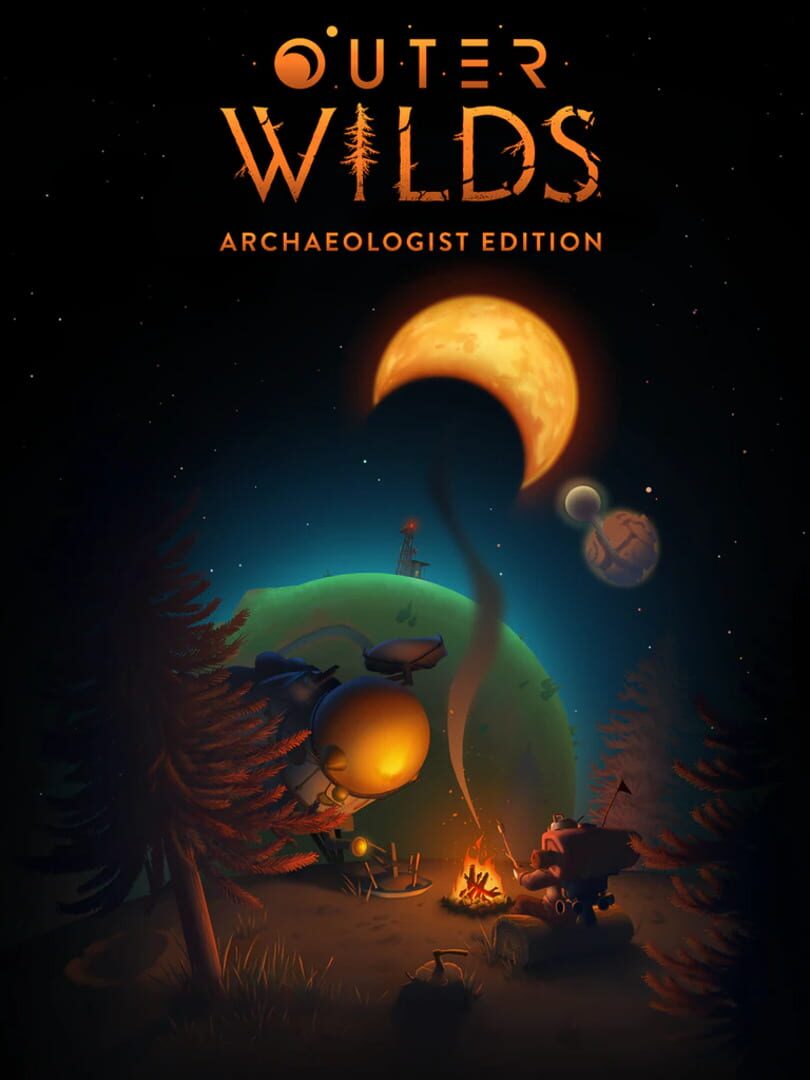
If you’ve been sleeping on Outer Wilds: Archaeologist Edition, we need to talk. When this game launched on September 28th, 2021, it didn’t arrive as some flashy AAA spectacle demanding your attention. Instead, Annapurna Interactive released something quietly revolutionary—a puzzle-adventure that fundamentally challenged how we think about exploration and discovery in games. The fact that it immediately garnered a perfect 10.0/10 rating wasn’t hype; it was recognition of something genuinely special.
What makes Outer Wilds so significant is that it dared to ask a question most games avoid: what if exploration wasn’t about collecting markers, but about collecting understanding? This is exploration stripped down to its philosophical core. You’re an astronaut in a solar system caught in a repeating 20-minute time loop, and you have nothing but curiosity and a spaceship to guide you. No quest markers. No objective list. Just the burning need to know what’s happening to this doomed star system.
The game’s genius lies in how it blends multiple genres into something entirely its own:
- Puzzle design that unfolds through environmental storytelling rather than contrived challenges
- Simulator mechanics that respect player agency and make the physics feel genuine
- Adventure sensibilities that prioritize wandering and wonder over combat or forced narrative beats
- Indie DNA that proves you don’t need massive budgets to create massive ideas
Each location you discover—whether it’s the crystalline structures of Brittle Hollow or the quantum-locked regions of the Quantum Moon—presents a complete ecosystem of clues. You’re essentially an archaeologist piecing together the mystery through ancient alien texts, architectural patterns, and the evidence left behind by a civilization that came before.
> What resonated with players wasn’t just the clever puzzle design or the elegant time loop mechanics. It was the feeling that the game trusted them completely—trusted them to explore without hand-holding, to fail and try again, to have genuine moments of revelation when understanding clicked into place.
The cultural impact of this release has been substantial, even if it hasn’t dominated headlines the way other Indies do. Outer Wilds sparked conversations about what adventure games could be in an era increasingly dominated by open-world fatigue. It proved that mystery and discovery don’t require endless content; they require meaningful information architecture. Every detail serves the larger puzzle. Every journey has purpose.
Annapurna Interactive’s decision to bring this to every major platform—Xbox Series X|S, PlayStation 5, PlayStation 4, Xbox One, Nintendo Switch, and PC—was crucial. This wasn’t a game designed for one audience. It was a game designed for thinkers, explorers, and curious minds everywhere. The Nintendo Switch port deserves particular recognition; it brought this innovative experience to players who might never have encountered it otherwise, proving that technical limitations don’t diminish brilliant design.
What’s particularly impressive is how the game handles its central mechanic without ever feeling gimmicky. The 20-minute loop isn’t a constraint; it’s the foundation of the entire experience. Every death, every reset, brings you closer to understanding. You’re not punished for your mortality—you’re accelerated toward revelation. This flips the script on how most games treat failure, transforming it into a natural part of the discovery process.
The archaeological framing of the Archaeologist Edition is more than cosmetic—it recontextualizes your entire journey. You’re not just exploring; you’re investigating. Each alien text you decipher, each mural you photograph, each technological artifact you study becomes a piece of a grander narrative. The game respects your intelligence enough to let you piece it together yourself, which is rarer than it should be.
Here’s what endures about Outer Wilds, years after its release:
- The mystery feels earned rather than handed to you—the best possible outcome for any puzzle-adventure
- The emotional payoff when you finally understand what’s happening hits differently because you worked for it
- The world-building is so complete that even environments you never fully explore feel lived-in and real
- The soundtrack amplifies the sense of cosmic mystery without ever overwhelming the experience
What makes this game genuinely important is that it proved indie developers could create experiences that rival or exceed what massive studios produce. Outer Wilds didn’t need cutting-edge graphics, endless DLC roadmaps, or live-service mechanics. It needed smart design, respect for the player’s time, and a genuine mystery worth solving. It delivered all three magnificently.
The game continues to inspire conversations about player agency, about what makes exploration meaningful, and about the power of mystery in gaming. When you’re discussing the most innovative puzzle-adventures of the 2020s, Outer Wilds: Archaeologist Edition sits at the top of the conversation—not because it was the loudest about its achievements, but because those achievements genuinely deserved to be heard.


