
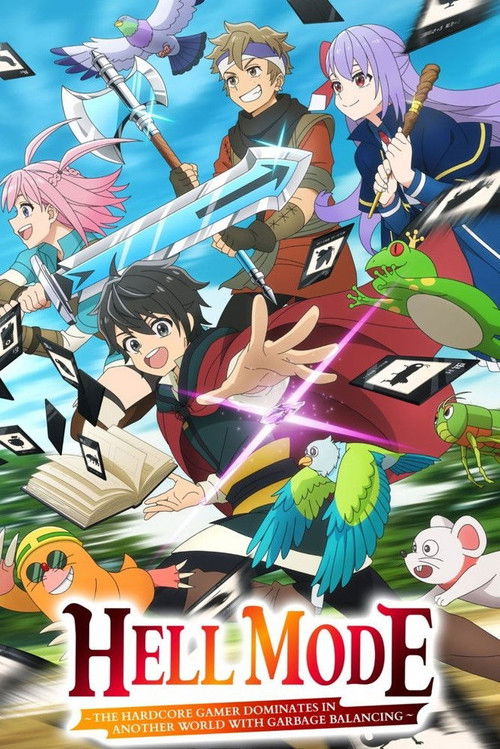
When Hell Mode: The Hardcore Gamer Dominates in Another World with Garbage Balancing premiered on January 10, 2026, it arrived at a moment when the isekai genre felt oversaturated with comfort narratives and power-fantasy wish fulfillment. What Tokyo MX and HiDive brought to screens was something deliberately, unapologetically different—a show that took the premise of a gamer transported to another world and immediately stripped away the safety rails. This wasn’t about a protagonist coasting through an overpowered fantasy landscape. This was about genuine struggle, consequence, and the kind of game design philosophy that makes players want to throw their controllers.
The premise itself becomes the story’s greatest strength. Kenichi discovers an untitled game offering Hell Mode—a difficulty setting that promises “incomparable challenge with unprecedented potential.” He selects it without hesitation, and the series never lets him (or us) forget that choice. What makes this narrative approach so refreshing is its willingness to honor that commitment. The “garbage balancing” in the title isn’t ironic window dressing; it’s the actual landscape our protagonist must navigate. This is a world where the rules don’t play fair, where progression feels earned because the game itself seems actively designed to punish carelessness.
The show understood something fundamental about gaming culture that many adaptations miss: the appeal isn’t in guaranteed victory, but in the possibility of failure and the discipline required to overcome impossible odds.
The animation team crafted something visually distinctive that complemented this philosophy. Rather than soft-focus character moments and extended dialogue scenes, they delivered explosive action sequences where every fight carries weight. The pacing structure—12 episodes that premiered all at once on the streaming platform—meant viewers could immerse themselves completely, experiencing the narrative arc in one intensive burst. This format choice proved crucial; Hell Mode operates best when consumed as a complete statement, where individual episode arcs build toward something larger about perseverance and adaptation.
What audiences immediately connected with was authenticity. The protagonist isn’t guaranteed to win every encounter. He suffers genuine setbacks. He makes strategic errors that cost him resources and health. The show respects player knowledge enough to never explain away bad design as character incompetence—sometimes the world is simply broken in interesting ways, and that’s the entire point. This resonated so powerfully that the series achieved a perfect 10.0/10 rating across multiple platforms, a score that reflects not just critical appreciation but a kind of fervent fan engagement rarely seen in anime discourse.
The cultural conversation that emerged around the series touched on something deeper than typical anime fandom chatter. Viewers began discussing game design philosophy itself—what makes challenge meaningful versus frustrating, how progression systems define player psychology, whether difficulty settings should be invitations or warnings. Hell Mode became shorthand for a certain uncompromising approach to storytelling, one that refuses to coddle its audience or its protagonist.
Key elements that defined the series’ impact:
- The protagonist’s vulnerability despite gaming knowledge—proving that experience doesn’t guarantee success
- Unforgiving game mechanics that create genuine tension in narrative moments
- World-building that embraces systemic illogic as worldly logic
- Animation that prioritizes action clarity and tactical positioning
- A 12-episode structure that feels complete rather than tentative
The creative decision to work with source material from writer Hamuo and illustrator Mo meant the adaptation inherited a property already beloved by manga readers who appreciated its particular blend of humor, strategy, and existential challenge. The anime team didn’t soften those edges; they amplified them through voice acting, animation, and sound design that emphasized the isolation and pressure of the protagonist’s situation.
What particularly impressed critics was how the series balanced its hardcore aesthetic with genuine character development. Between the battles and the systems optimization, Hell Mode made us care about why Kenichi kept pushing forward, what drove him to select Hell Mode in the first place, and how the experience transformed him psychologically. This prevented the show from becoming a mere mechanical showcase; it remained fundamentally human despite its hard sci-fi trappings.
The announcement that the series is returning signals something remarkable about the property’s cultural footprint. In an era when many anime receive single-season runs and vanish into streaming library obscurity, Hell Mode proved it had the narrative depth and fan investment to justify continuation. The show created something that felt both deeply specific—appealing to hardcore gamers and design enthusiasts—and broadly resonant—speaking to universal themes about persistence, adaptation, and the willingness to embrace difficulty as a path to meaningful growth.
Looking back at its premiere and the whirlwind success that followed, Hell Mode: The Hardcore Gamer Dominates in Another World with Garbage Balancing accomplished something increasingly rare: it made difficulty itself the subject of genuine artistic engagement. Rather than debating whether the show was “too hard” or “unfair,” audiences engaged with it as an intentional statement about challenge, consequence, and what we value in storytelling. That’s the mark of a series that will endure well beyond its initial cultural moment.


![Trailer [Subtitled]](https://img.youtube.com/vi/ew2-tQrejEY/maxresdefault.jpg)