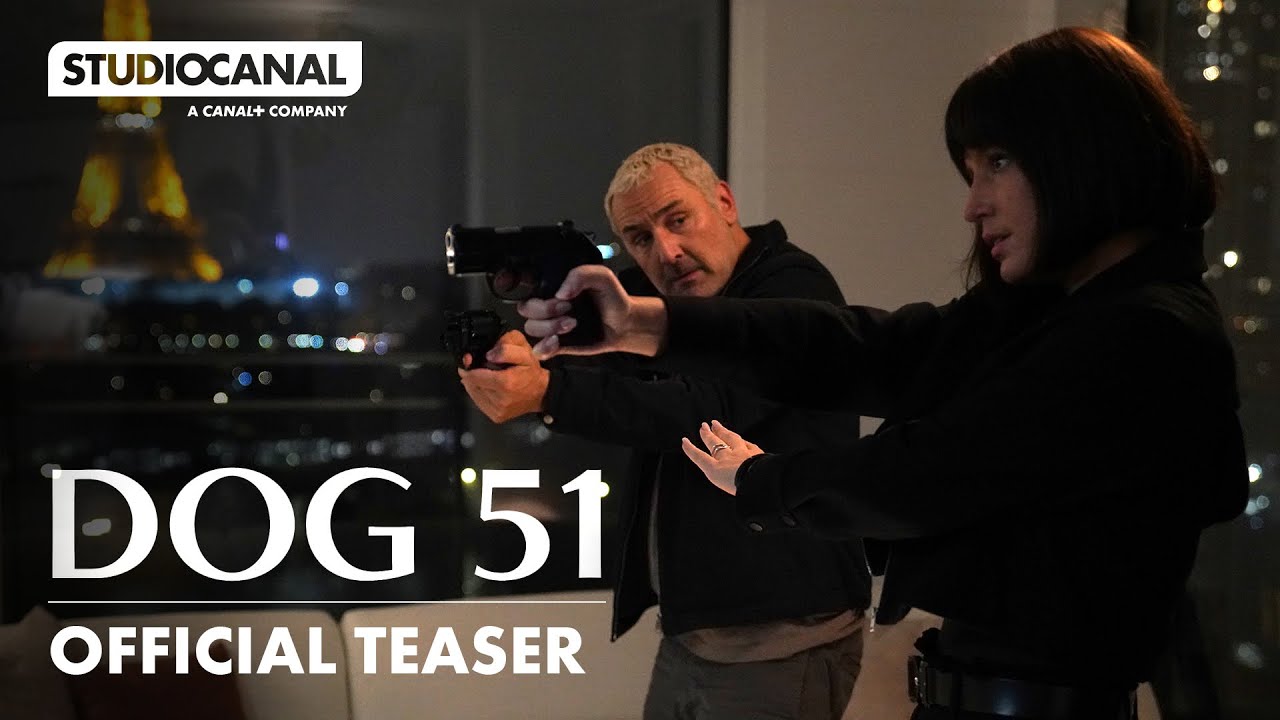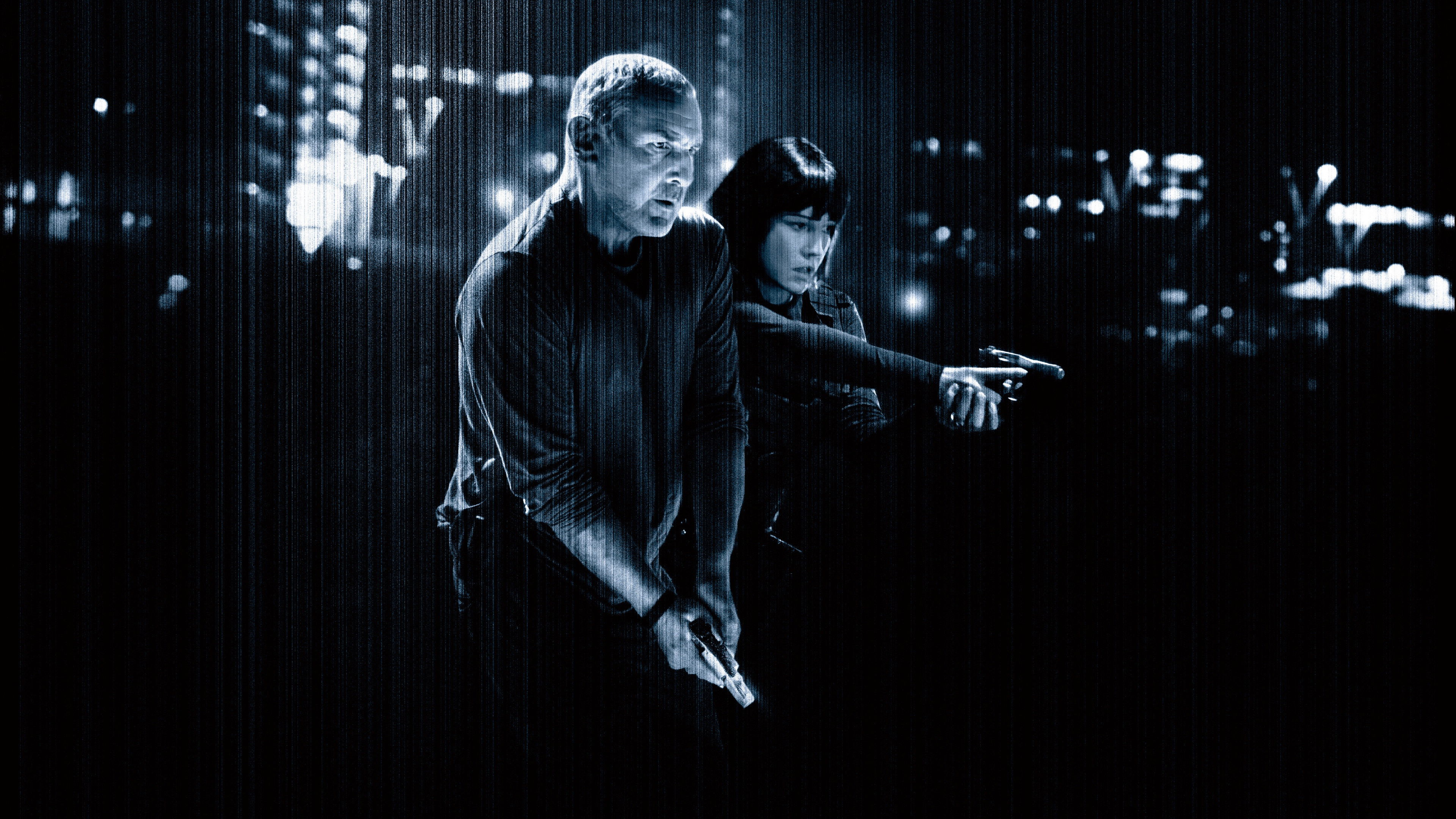
When Dog 51 premiered as the closing night film at the 82nd Venice International Film Festival, it arrived with considerable weight behind it—a French-Belgian co-production backed by StudioCanal that represented one of the country’s most ambitious theatrical ventures of 2025. Yet what made this film genuinely significant wasn’t just its pedigree or production scale. Rather, it was Cédric Jimenez’s willingness to wrestle with contemporary anxieties about surveillance, artificial intelligence, and social fragmentation in a way that felt both intellectually rigorous and urgently immediate.
The film’s premise is deceptively straightforward: in a future Paris fractured by class warfare, an omniscient AI system called ALMA maintains an uneasy social order. When its creator is murdered, two unlikely partners—a top-tier intelligence operative and a burned-out cop—must navigate a labyrinth of corporate interests, state power, and hidden truths. But Jimenez understands that the real tension doesn’t lie in the plot mechanics alone. It’s in how the story uses a divided city as both setting and character, making spatial segregation the visual language through which we understand systemic corruption.
> In a city divided, they fight for the truth. This tagline captures something essential about why the film resonates beyond its thriller framework—it’s fundamentally concerned with who gets to define reality in an age of algorithmic control.
What’s particularly noteworthy is how Jimenez compressed this ambitious worldbuilding into a lean 1 hour 40 minutes of screen time. There’s a real discipline here that resists the contemporary temptation toward bloat. The brevity forces every scene to earn its place, every visual flourish to serve the larger thematic inquiry. That runtime becomes a statement in itself—that you don’t need three hours to interrogate the nature of truth in an AI-governed society.
The casting choices reveal much about Jimenez’s sensibility:
- Gilles Lellouche brings a weathered intensity to the intelligence operative—he’s played morally compromised characters before, but here he embodies a man trapped between competing systems of power with no safe ground beneath his feet
- Adèle Exarchopoulos grounds the narrative as the weary cop whose street-level perspective becomes the audience’s entry point into the film’s investigative machinery
- Louis Garrel rounds out the ensemble, adding another layer of ambiguity to a narrative that deliberately refuses to offer easy moral clarity
These three actors don’t play heroes or villains—they inhabit functional roles within corrupt institutions, which makes their performances far more unsettling than traditional character arcs might allow.
The film’s critical reception told an interesting story. With a 6.4/10 rating across 163 votes, Dog 51 occupied that curious middle ground where audiences seemed divided on its merits. Some found it a sharp, prescient examination of technological control; others perhaps wanted more conventional thriller satisfaction. That division itself feels honest—this isn’t a film designed to please everyone. It’s deliberately uncomfortable in its refusal to offer redemptive character arcs or tidy resolutions. The uncertainty audiences experienced watching it mirrors the uncertainty the characters themselves inhabit.
What’s remarkable, particularly in retrospect, is how Dog 51 anticipated broader cultural anxieties that would only intensify in the years following its release. Science fiction cinema has long struggled with questions of surveillance and AI ethics, but Jimenez approaches these themes without resorting to dystopian melodrama. His future Paris doesn’t feel like a fever dream—it feels like an extrapolation, a logical progression of existing inequalities rendered spatial and technological.
The film’s box office performance—reportedly grossing an estimated $1.17 billion against an unknown budget—suggests that audiences worldwide responded to something fundamental in its premise, even if critical consensus remained fractured. European audiences in particular seemed to recognize themselves in the film’s preoccupations with state power, corporate influence, and the fragile social contracts we rely upon.
Why Dog 51 matters beyond 2025:
- It represents a moment when European thriller cinema embraced explicitly science-fictional frameworks without abandoning grounded character work
- The collaboration between StudioCanal, Chi-Fou-Mi Productions, and France 2 Cinéma demonstrated that ambitious auteurist filmmaking could still secure mainstream distribution
- Jimenez proved that you don’t need sprawling runtime or elaborate set pieces to create a genuinely unsettling vision of near-future social collapse
- It opened conversations about how cinema could visualize algorithmic governance—a challenge few filmmakers have tackled with such seriousness
The American premiere came later through the American French Film Festival in Los Angeles, introducing North American audiences to what European cinephiles had already recognized: a film of genuine intellectual ambition wrapped in the propulsive machinery of a thriller. That Jimenez could balance philosophical inquiry with narrative momentum—could make you think and keep you watching—marks him as a director with something important to say about our present moment.
In an era when science fiction often defaults to spectacle or resignation, Dog 51 insisted on something more difficult: that cinema could still function as a space for serious political and ethical thought. The fact that it arrived with all the institutional backing of a major European studio, that it premiered at Venice, that it reached a genuinely global audience—this matters. It means audiences still want films that challenge them, that refuse easy answers, that trust viewers to sit with complexity and ambiguity.


![Official Trailer [Subtitled]](https://img.youtube.com/vi/nBizRrKtVc0/maxresdefault.jpg)