When Bingo Bongo premiered on December 23, 1982, Italian cinema was in a playful mood. Director Pasquale Festa Campanile tapped into something wonderfully absurd—a fish-out-of-water comedy about a Tarzan-like man discovered in the Congo and transplanted into the heart of Milan.
On the surface, it sounds like a simple gimmick, but what Campanile actually created was a clever satire wrapped in family-friendly entertainment, complete with genuine heart underneath the slapstick chaos.
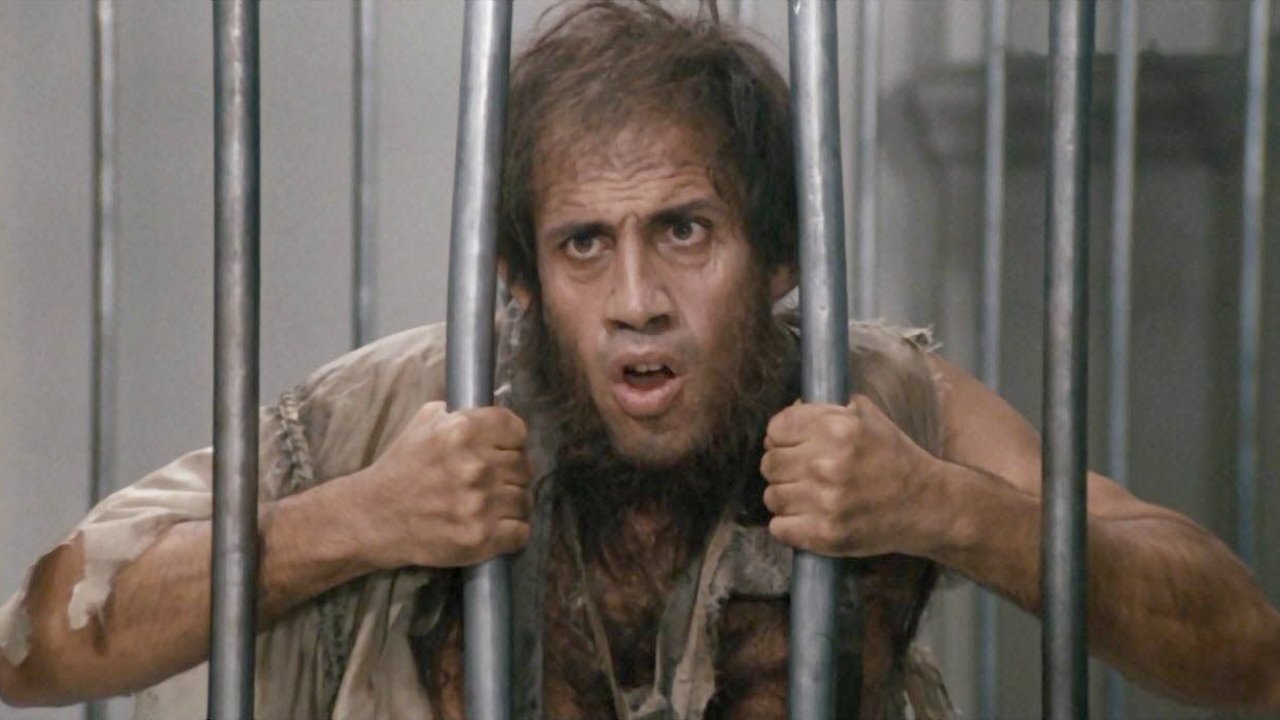
The film’s premise is delightfully straightforward: a feral man is brought to civilization, and Adriano Celentano carries the entire weight of this fish-out-of-water narrative with remarkable commitment. Rather than playing the role as mere comic relief, Celentano brings an earnest vulnerability to his protagonist. He’s not just a joke—he’s a mirror held up to urban society, reacting with genuine bewilderment to our customs and conventions. It’s Tarzan meets Singin’ in the Rain, if you will.
The genius of Bingo Bongo lies in its willingness to question what “civilization” actually means. Is the jungle man truly uncivilized, or is modern Milan the real wilderness?
Supporting this central performance is Carole Bouquet, who grounds the film with her role as Laura, the anthropologist who becomes the emotional anchor of the story. She’s not just a love interest; she’s the bridge between two worlds, advocating for the film’s implicit thesis: that humanity transcends geography and breeding.
Their chemistry works precisely because it avoids cynicism. And Felice Andreasi rounds out the cast, contributing to the ensemble dynamics that make the 1 hour 42 minute runtime feel generous rather than restrictive.
What makes this collaboration particularly significant is how it avoids the traps many films of its era fell into:
- It doesn’t mock its own premise—the film plays the situation straight, allowing genuine humor to emerge from context rather than cruelty
- The tone remains playful without becoming condescending—toward either its protagonist or its audience
- It respects the intelligence of younger viewers while offering adults something to chew on thematically
- The pacing moves briskly, using its modest runtime to maintain momentum and energy
The critical reception over the decades has been… well, let’s call it mixed. A 5.7/10 rating from contemporary critics tells you something, but perhaps not what you’d initially assume. This wasn’t a film that demanded critical prestige or artistic awards.
It was designed to entertain, and by its own modest standards, it absolutely succeeded. The real measure came at the Italian box office, where Bingo Bongo demonstrated solid commercial performance, ranking ninth among the highest-grossing films of the 1982-83 season in its home market. That’s significant—not blockbuster territory, but respectable enough to indicate genuine audience enthusiasm.
What becomes clear when you examine Bingo Bongo through a contemporary lens is how it represents a particular moment in Italian comedy cinema.
The early 1980s were a fascinating period: the giallo craze was fading, spaghetti westerns belonged to history, but comedies remained a vital part of the industry’s output. Festa Campanile understood that comedy wasn’t about being clever—it was about being honest.
The film’s cultural legacy might seem slim on the surface, but consider what it accomplished:
- It demonstrated that mainstream comedy could address social themes without becoming preachy or losing its entertainment value
- It gave Celentano a memorable starring vehicle that played to his underrated physical comedy skills
- It proved that the “noble savage” trope could be subverted rather than reinforced, by making the “civilized” world seem equally strange
- It created a template for subsequent fish-out-of-water comedies that prioritize character over cynicism
What resonates about Bingo Bongo today, even as it fades into obscurity, is precisely this earnestness. Modern comedy often punches down or relies on ironic distance. This film simply… cares. It cares about its characters, even (especially) the one that polite society initially dismisses.
Pasquale Festa Campanile assembled a cast and crew willing to commit fully to a premise that could have easily become contemptible, and they managed something genuinely rare: entertainment with a conscience.
The film premiered across multiple territories throughout 1983 and beyond, finding audiences in West Germany, Spain, Colombia, and France. This international release schedule speaks to its modest but genuine cross-cultural appeal. It wasn’t a phenomenon, but it was a legitimate entertainment that found its audience organically. In an era before social media virality, that’s almost impressive in itself.


![Bingo Bongo (1982) DEUTSCH TRAILER [HD 1080p]](https://img.youtube.com/vi/Z3aVa2a-la4/maxresdefault.jpg)